

Aftab Anwar Baloch
Pakistan is undertaking one of the most significant trade-monitoring reforms in its history with the introduction of a nationwide cargo tracking system (CTS). The initiative is designed to replace the country’s paper-based transport documentation with a fully digital platform capable of monitoring the movement of goods from origin to destination in near real time.
At the centre of the reform is the replacement of the traditional bilty, the handwritten consignment note that has for decades accompanied goods moving across Pakistan. Although simple and familiar, the bilty offers little transparency and has long provided opportunities for smuggling, under-invoicing and tax evasion.
The new e-Bilty system will create a secure digital record of each shipment and link transport documentation with customs declarations, tax invoices and enforcement databases. In doing so, Pakistan hopes to build a comprehensive audit trail for goods moving through its economy and reduce an estimated tax gap of PKR 7.1 trillion ($25.5 billion).
From paper bilty to digital visibility
For generations, cargo movement in Pakistan has been documented by a small, often crumpled paper slip prepared at truck stands and passed from consignor to transporter and consignee. This informal process has remained largely unchanged despite the increasing complexity and scale of domestic and international trade.
The cargo tracking system will fundamentally alter this process. Before a shipment begins its journey, the consignor will enter details such as the nature, quantity and value of the goods, the tax identities of the consignor and consignee, the vehicle registration number and the destination into a central online portal. The system will then generate a unique QR code that serves as a digital seal for the consignment.
Enforcement officers will be able to scan this code at any point during transit and immediately confirm whether the shipment corresponds to a declared and tax-compliant transaction.
International Standards and Global Practice
Pakistan’s initiative is closely aligned with international customs and border management standards, including the Revised Kyoto Convention, the SAFE Framework of Standards developed by the World Customs Organisation and the World Trade Organisation Trade Facilitation Agreement.
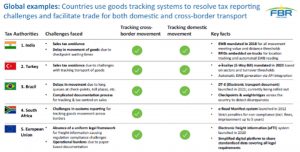
These frameworks encourage customs administrations to adopt risk-based controls that focus attention on high-risk consignments while facilitating legitimate trade. Pakistan is therefore following a path already taken by countries such as China, India, Brazil and members of the European Union, all of which have introduced digital systems to improve cargo visibility and compliance.
Legal foundation and project leadership
The legal basis for the CTS was established in Pakistan’s Finance Bill 2025, which introduced a regulatory framework for digital cargo monitoring. Funding is being provided by the World Bank under the Pakistan Raises Revenue Program, while implementation is being led by the National Targeting Centre (NTC), the Federal Board of Revenue’s central intelligence and risk-analysis unit.
A major milestone was reached in March 2026, when the Federal Board of Revenue formally launched the design phase for the CTS and the integrated e-Bilty mechanism.
Technology architecture
The CTS combines several technologies to create a continuous digital record of cargo movement. Every shipment will be associated with a QR-coded e-Bilty, providing a simple and immediately verifiable link between the physical consignment and its digital record.
For higher-risk goods, including transit cargo and petroleum products, vehicles may be equipped with GPS devices that transmit their location, speed and route data in real time. Lower-risk consignments may instead use RFID tags that can be automatically detected at checkpoints and logistics hubs.
The information generated by these technologies will be analysed using artificial intelligence tools that can detect anomalies such as unexpected route deviations, prolonged stoppages or discrepancies between declared and transported goods.
Integration with government systems
One of the most important features of the CTS is its integration with Pakistan’s wider digital infrastructure. The system is intended to connect with core Federal Board of Revenue platforms, including the Web-Based One Customs clearance system, the Pakistan Single Window, the Sales Tax Real-Time Invoice Verification and Enforcement system and the Anti-Smuggling Portal. It will also interface with external databases such as the National Database and Registration Authority and provincial vehicle registration departments.
This integration will allow authorities to link import declarations, tax invoices and transport records into a single chain of verified information. As a result, officials will be able to trace goods from the point of import or manufacture through to their final destination.
International consultancy and rollout
Following an open international tender involving six foreign bidders, the design and feasibility contract was awarded to Moon Engineering in a joint venture.
The consultancy is responsible for mapping existing cargo practices, reviewing legal and policy requirements, defining the technical architecture, estimating costs and preparing an implementation roadmap.
The project will proceed in two phases. The first phase, currently underway, focuses on feasibility, design and stakeholder consultation. The second phase will cover system development, pilot testing and phased national deployment, which is expected to take a further 18 to 24 months.
The National Targeting Centre
The true value of the CTS will be realised when its data is combined with other intelligence sources within the National Targeting Centre.
The NTC already operates several advanced systems, including the Global Travelers
Assessment System, the Currency Declaration System, the National Customs Enforcement Network and the Customs Interdiction Module. By integrating cargo data with information from these and other law enforcement databases, authorities will be able to identify suspicious patterns and target enforcement more effectively.
This approach reflects modern customs practice, where intelligence and data analytics increasingly replace manual controls and routine inspections.
Economic and enforcement benefits
The principal objective of the CTS is to protect government revenue by reducing smuggling, under-invoicing and tax evasion. However, its significance extends well beyond tax collection.
By creating a reliable digital trail for the movement of goods, the system will encourage businesses operating informally to enter the documented economy. Compliant businesses should benefit from a more level playing field, while policymakers will gain access to richer and more accurate trade data.
At the same time, enforcement agencies will have stronger tools to distinguish compliant consignments from suspicious ones, enabling them to focus resources where they are most needed.
A structural reform
Pakistan’s cargo tracking system represents far more than the replacement of one document with another. It is a structural reform that seeks to redefine the relationship between the state and the movement of goods across the country.
When the traditional paper bilty is finally retired and e-Bilty QR codes become a routine feature of roadside inspections, Pakistan will have taken a major step towards a more transparent, accountable and digitally integrated trading environment.
If implemented effectively, the CTS has the potential to become one of the most consequential customs and tax modernisation initiatives in Pakistan’s history.
