

Aftab Anwar Baloch
The Track and Trace System (TTS) has emerged globally as a highly effective mechanism to combat illicit trade, enhance tax compliance, and strengthen regulatory oversight across high-risk sectors. By enabling real-time monitoring of production, distribution, and sales through secure digital traceability and overt/covert authentication features, , TTS ensures transparency in specified industry supply chains and minimizes opportunities for tax evasion. Countries that have implemented advanced track-and-trace frameworks on excisable goods have reported significant improvements in revenue collection, reduced illicit activity, and strengthened enforcement capabilities. International best practices emphasize TTS as a cornerstone policy tool to curb illicit tobacco trade and safeguard public revenues.
Beyond revenue mobilization, TTS delivers broader governance and economic benefits. It enhances institutional accountability, facilitates data-driven policymaking, and creates a level playing field for compliant businesses by curbing unfair competition from illicit operators. Evidence from jurisdictions in Europe, the Middle East, and parts of Asia demonstrates that robust TTS implementation in vulnerable industries not only reduces tax leakage but also improves market formalization and investor confidence. These outcomes are particularly relevant for developing economies where illicit trade significantly undermines fiscal stability and public funding and health objectives.
In Pakistan, the Federal Board of Revenue (FBR), authority responsible for tax collection and administration, launched an ambitious initiative in 2021 by rolling out a Track and Trace System across several key sectors, initially on tobacco, and moving on to sugar, fertilizer, and cement with subsequent plans to extend the system to beverages, fuels, and several other sectors. When the TTS system initially launched in 2021, the system faced staunch opposition from industry, who raised concerns about the costs to implementation of the program. These efforts by industry originally stalled the implementation of the program for several months including delays brought on by legal challenges filed by several losing bidders and some manufacturers, all of which were ultimately dismissed…. Since these delays, TTS has been successfully rolled out in the four industries and has demonstrated continuity and effectiveness, contributing to improved documentation of production and a notable increase in tax collection, thereby reinforcing its credibility as a sustainable enforcement tool. The revenue collected during 2023-24 was 237 billion as , compared to Rs 142 billion in FY 2022–23, reflecting a substantial increase of Rs 95 billion, or 70%. Similarly, sales tax collection from locally produced cigarettes rose to Rs 60.664 billion in 2023–24 from Rs 36.926 billion in the previous year, marking a 54.3% increase. Cigarettes accounted for 41% of total excise collection within their category (source: FBR annual revenue data, 2024).
Pakistan is the signatory to WHO Framework Convention on Tobacco Control (FCTC) and Protocol and accordingly launched the National Tobacco Control Strategy (2022– 2030). However, translating these commitments into tangible action remains a challenge.
Pakistan has high tobacco usage and large health costs (over 163,600 deaths annually and PKR 422 billion economic burden).
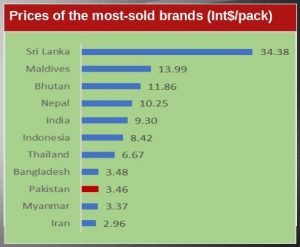
Pakistan has one of the lowest cigarette prices in the world when adjusted for purchasing power. A pack costs just $ 3.46 (PPP) in Pakistan, half the Eastern Mediterranean average ($ 6.32), and roughly one third in the South-east Asia average ($ 10.91). The fact that regional peers sustain much higher prices without social or economic disruption shows that Pakistan has substantial and safe room to raise tobacco taxes.
Pakistan currently does not have an effective taxation framework as tobacco companies influence the system by lobbying policymakers and exploiting the multi-tier tax structure, which makes it difficult for FBR to implement strong tax reforms. There is a need to enhance taxes on cigarettes and other tobacco and these taxes should be increased as the nominal FED has remained unchanged since February 2023, but high inflation has sharply eroded its real term impact.
The independent think tanks and the researchers in their recent studies have brought in startling and shocking facts. According to the research for economy brands, the inflation adjusted FED has fallen from Rs 101 to Rs 78.59 per pack by January 2026. They pointed out that incomes and other prices rise but tobacco taxes don’t and cigarettes become more affordable relative to essentials like food, fuel, and education. By not indexing the FED to real time inflation, the government effectively grants the tobacco industry a yearly tax holiday, losing both inflation adjusted revenue and health gains.
These research conclusions also indicate that while recent IMF-driven tax hikes reduced cigarette sales by an estimated 20–25%, the multi-tiered excise tax system keeps budget brands affordably priced, undermining public health objectives. This affordability fuels youth addiction and weakens overall control efforts. Moreover, the introduction and mushrooming use of HTPs ( Heated Tobacco Products) and Smokeless Tobacco (ST) in Pakistan amongst the youth, middle, lower middle and affluent class has further aggravated the situation.
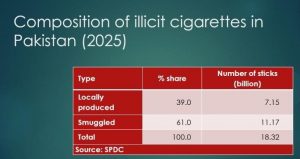
Due to sucesssful implementation of Track and Trace System duly complemented by enforcement drives and effective monitoring, a trend has been observed indicating increased illicit trade shifting towards smuggled imported cigarettes, with their market share reportedly exceeding the locally produced illicit products.
Another emerging concern is the rapid shift in consumer preferences toward alternative nicotine products, including e-cigarettes, vapes, and nicotine pouches. These products currently operate in a largely unregulated space, lacking a clear taxation and regulatory framework. Similarly, smokeless tobacco products remain insufficiently monitored. The absence of comprehensive policies in this domain risks undermining broader tobacco control efforts and necessitates immediate regulatory attention.
Looking ahead after successful results of track and trace system initially implemented on four industries, the government is now aiming to expand the net and scope of the Track and Trace System to other high-risk sectors, like fuel, tyres, iron and steel, tiles, pharmaceuticals,s beverages, and fabrics. These sectors have been identified based on significant revenue leakage potential. For instance, the tile industry alone is estimated to evade approximately Rs 30 billion annually (source: FBR internal estimates, 2025–2026). Request for Information (RFI) was issued in January 2026, seeking advanced technological solutions to enhance future TTS iterations in other sectors.
The efficacy of these enforcement measures is however frequently marred by tiny issues like the recent controversy raised by the FBR regarding the effective expiry date of the initial TTS contract. The disagreement stems from the contract’s signing date which differed from the actual operational “go-live” dates of the sectors covered by the program. This difference in interpretation of expiry date caused additional delays and frustrations between the FBR and the primary solution provider responsible for operating the program. Law Division came to the rescue of the solution provider by reportedly advising that the contract duration should be calculated based on operational timelines and treated as a unified system across all sectors which confirmed an expiry date well into 2029. These small hiccups and unnecessary administrative blockages result in material losses of time and energy in sorting out frivolous legal and contractual matters shaking the confidence of existing international investors and other intended international solution providers considering entry into the Pakistan market. There is need for FBR to avoid these sort of gimmicks in the immediate future and allow the TTS system to work smoothly and reach the objectives intended.
The panacea to these economic and administrative challenges lies in strengthening the Track and Trace System and adopting more rigorous enforcement and monitoring measures. Thus, technology remains the most viable solution to counter the increasingly sophisticated tactics of tax evaders, who manipulate production volumes and exploit porous borders. Experts and stakeholders emphasize that the existing TTS is more effective than alternative mechanisms, such as video monitoring, and recommends allowing the contract to continue intact until its adjusted completion period.
The Track and Trace System has already demonstrated its potential by increasing transparency and boosting revenue collection in key sectors. However, sustaining these gains requires long-term institutional commitment, policy coherence, and continued investment in enforcement capacity. As the country grapples with fiscal constraints and rising economic pressures particularly during the present times of war in the middle east, vulnerability of energy and fuel constraints and economic uncertainty, strengthening such mechanisms is not merely an option but now an imperative.
Moreover, adoption of a comprehensive and forward-looking approach to tobacco control is gaining importance day by day. This includes gradually transitioning to a single-tier excise tax system, ensuring inflation indexation of tobacco taxes, strengthening enforcement against illicit trade particularly smuggled products and developing robust regulatory frameworks for emerging nicotine products. Pakistan should align its long-term goals with the WHO’s 3 by 35 Initiative[2025] which aims to increase taxes on tobacco, alcohol and sugary drinks with the aim to increase the real prices of tobacco, alcohol, and sugary drinks 50% by 2035.
The government must act and move to enlarge the scope of TTS to other sectors prone to smuggling and tax evasion. FBR also should honor its contractual commitment to the TTS solution provider who has continued to deploy and honor its commitments despite the frivolous delay via industry and financial hardships brought on by FBR administrative squabbles over contract issues. The IMF and other international donors are increasingly pushing for the tax reforms, emphasizing that the adoption of technological solutions is a non-negotiable condition for financial stability. By plugging these loopholes, Pakistan can maximize its domestic revenue potential and move away from its historical dependence on external bailouts.
In the current “cash-strapped” conditions and scenario the transition from a “begging bowl” economy to a self-sustaining one depends entirely on the state’s ability to use advanced technology like TTS to capture every rupee of tax owed and bring advantage to compliant manufactures. Expanding these operations is the only way for Pakistan to stand on its own feet and build a transparent, documented, and prosperous future.

