

Zarmina Khan
Gender-Based Violence (GBV) is often described as a crime involving harmful acts carried out against individuals based on their gender. It is a serious human rights issue and a major public health and social problem that affects individuals, families, and communities. However, GBV is far more than just a crime. It is a deeply rooted crisis that affects the social fabric, the economy, public health systems, and the overall development of a nation.
There are different types of Gender Based Violence. Physical violence involves the use of physical force intended to cause harm, injury, or pain. Sexual violence includes any sexual act carried out without a person’s consent, including harassment and exploitation. Psychological violence involves actions that harm a person’s self-esteem, mental wellbeing, or sense of security, such as insults, threats, and intimidation. Economic violence occurs when a person is denied access to financial resources, education, or employment in order to control or limit their independence.
Gender Based Violence appears in different forms. Domestic violence is a type of abuse that occurs within the family or intimate relationships. Sexual harassment comprises unwanted sexual comments or behaviors that violate a person’s dignity. Harmful practices refer to certain social practices, such as forced or early marriage, denial of education, and discriminatory inheritance practices, that negatively affect an individual’s health, safety, and dignity. Human trafficking involves the exploitation of people for labor or sexual purposes. Digital violence includes cyberbullying, harassment, or threats directed at individuals based on their gender.
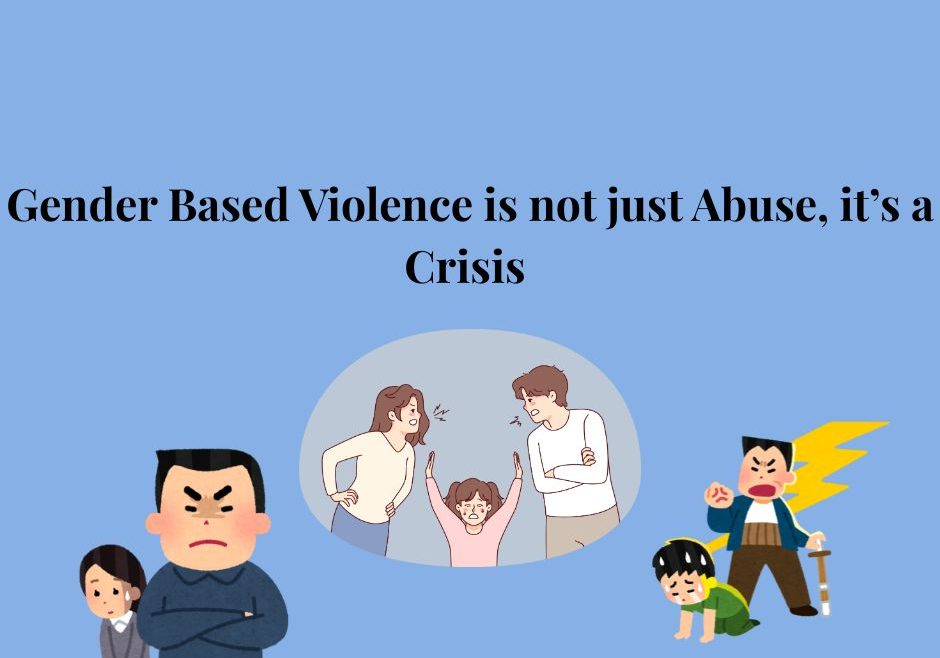
No doubt, the different types and forms of Gender Based Violence show how severely it affects people, but GBV is far more than that. It is a structural, Social, public health, development, institutional and multigenerational crisis due to its widespread causes and impacts.
While laws exist to protect women, children, and vulnerable groups, the persistence of GBV incidents reveals that it is a structural crisis, not merely a matter of individual behavior. From domestic abuse and honor-based crimes to workplace harassment and child violence, GBV continues to threaten human rights and destabilize families across the country.
Gender Based Violence affects women, men, children, old persons and transgender people in Pakistan. Its prevalence is so high that GBV has become a social crisis, rather than an isolated criminal issue. Many cases go unreported due to fear, stigma, or lack of trust in the justice system. According to surveys and reports by national and international organizations, a significant proportion of women, children, transgender people, and older adults in Pakistan experience some form of physical or emotional violence during their lifetime. Disturbingly, some transgender individuals have been murdered; for instance, three transgender people were shot dead and their bodies found on a highway in Karachi. A 2023 report in the Lancet journal revealed that nearly 90 percent of transgender people in Pakistan face physical violence.
Patriarchal norms, harmful gender stereotypes, economic dependency, and the normalization of violence within intimate relationships often act as key catalysts for GBV.
GBV has long term physical and psychological consequences. Survivors often face trauma, mental health issues, injuries and chronic health problems. These effects run through families and communities, which makes GBV a public health crisis.
Beyond public health, GBV is also a developmental crisis. Violence hampers women’s participation in education, employment, and social life, which leads to loss of economic opportunities and social isolation. When half the population is unsafe and under pressure, then how can national development, productivity, and progress be achieved? Gender based violence undermines social and economic progress. It disrupts education, reduces productivity, increases healthcare costs, and perpetuates poverty. Pakistan loses a significant portion of its capital each year due to the consequences of GBV. It holds back national growth and equality efforts.
GBV also highlights an institutional gap. When survivors report cases, they may face slow legal processes and inadequate protection, which creates distrust between citizens and institutions. For instance, in Kasur, a rape victim attempted to burn herself after a local court decided to acquit the accused.
GBV creates a cycle across generations. According to Social Learning Theory, people learn violent behavior by observing others, especially in families or communities where violence is normalized. Children who witness GBV are more likely to develop trauma and may learn to normalize or repeat violent behaviors, affecting the people around them. In many households, domestic conflict is common, and children become silent victims. Growing up in an environment of fear and violence badly affects their emotional and cognitive development. People experience behavioral problems, anxiety, or trauma that lasts throughout their lives. A particularly painful reality is that some abusers project their anger onto their children. This creates intergenerational cycles of violence, in which children raised in abusive homes often struggle with relationships later in life. A mother killed her two young children due to a conflict with her ex-husband in Karachi, and her ex-husband claimed that she was mentally ill, which also highlights the consequences of disturbed mental health. GBV just doesn’t destroy only individuals but also future generations. Thus, GBV becomes a multigenerational crisis unless actively addressed. In Pakistan, access to mental health services is limited, especially for women in rural areas, which further intensifies the crisis.
Domestic violence is one of the leading causes of homelessness. Many women, however, continue to endure abuse but do not leave home, while some flee abusive homes with their children but find themselves with nowhere safe to go. Some women do not return to their parents’ homes due to fear of burdening them or disrupting Family dynamics. Shelters such as Dar ul Aman are often overcrowded, underfunded, or lack long-term support. Homeless women face greater risks of sexual exploitation, trafficking, and violence. The fear of becoming homeless often forces survivors to remain in abusive situations, illustrating how GBV is linked to broader social vulnerabilities.
Victims who speak out are often blamed and shamed, and it discourages others from seeking help. Social support system is weak, and families sometimes prioritize reputation over justice. In some cases, family members have killed females to prevent marriages or preserve honor. Several similar cases have been documented across Pakistan, where honor killings are carried out by members of the victim’s own family. In Bahawalpur, a father and a son are suspected of killing the daughter on her wedding day because they both didn’t want her to marry that guy and they abandoned her dead body in fields. Therefore, the issue of Gender-Based Violence requires a change in mindsets and social attitudes, not just legal punishment.
Pakistan has formulated several laws to combat GBV, such as the Protection Against Harassment of Women at the Workplace Act, 2010, which addresses harassment in professional settings; and provisions under the Pakistan Penal Code covering rape, honor killings, and other forms of sexual violence.
In addition, each province has its own domestic violence laws, for example, the Sindh Domestic Violence (Prevention and Protection) Act 2013, the Punjab Protection of Women Against Violence Act 2016, the Balochistan Domestic Violence (Prevention and Protection) Act 2014, and the Khyber Pakhtunkhwa Domestic Violence Against Women (Prevention and Protection) Act 2013. These laws provide mechanisms for reporting, protection orders, and penalties for perpetrators.
Despite these legal frameworks, implementation remains uneven. Police responses can be slow due to insufficient evidences or external pressure, and survivors may face intimidation when reporting cases. Legal processes are often lengthy and emotionally draining, which discourages victims from seeking justice. While NGOs, women’s rights activists, and government programs have made progress in awareness-raising, legal aid, and victim support, but challenges remain in enforcement, monitoring, and access to justice, particularly in rural areas.
Laws alone are not enough to change social mentalities. Societal norms that tolerate violence must be challenged through education and mass awareness. Trust between institutions and the people must be strengthened through proper implementation of policies, laws, and needed reforms, while healthcare and social services need adequate training, resources, and accountability mechanisms to address GBV effectively. Survivor support is crucial, including safe shelters, mental health services, legal aid, and financial assistance.
Thus, GBV is not just a crime but a crisis that exposes social inequalities, slow institutional responses, toxic domestic environments, and inadequate public health support. To address GBV, it is important to invest in education, women’s empowerment, institutional reforms, and accessible justice.

